ShipAssist
A backend-first WhatsApp automation that detects user language, extracts tracking numbers, and replies with shipment status updates using APIs and AI tools.
Overview
Many logistics and delivery businesses answer shipment questions manually on WhatsApp. ShipAssist helps automate these conversations so customers get quick and consistent updates.
What it does
- Receives incoming WhatsApp messages through webhooks (Meta WhatsApp Cloud API).
- Detects the customer’s language and responds in that language.
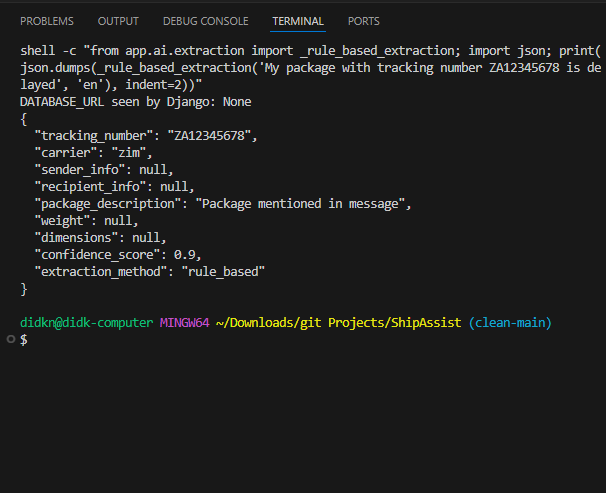
- Extracts tracking numbers from free-text messages.
- Looks up shipment status from an external service or workflow.
- Sends a clear status reply back to the customer.
How it works (simple flow)
- Customer message → webhook
- Validate + parse message
- Language detection + tracking extraction
- Status lookup (API / n8n workflow)
- Reply to customer
My role / What I built
- Designed the backend structure and API logic using Django and Django REST Framework.
- Built webhook endpoints to receive and verify WhatsApp Cloud API events.
- Implemented parsing, validation, and response handling.
- Prepared outbound messaging endpoints for sending replies and notifications.
- Configured environment-based settings and credentials (tokens, API keys, .env).
- Designed the integration points for automation workflows (n8n) and external services.
Tech stack
- Backend: Python, Django, Django REST Framework
- Integrations: Meta WhatsApp Cloud API, Webhooks, REST APIs
- Automation: n8n (workflow integration), OpenAI (message understanding / language support)
- Tools: Git/GitHub, environment-based config (.env), Docker (planned)
Screenshots
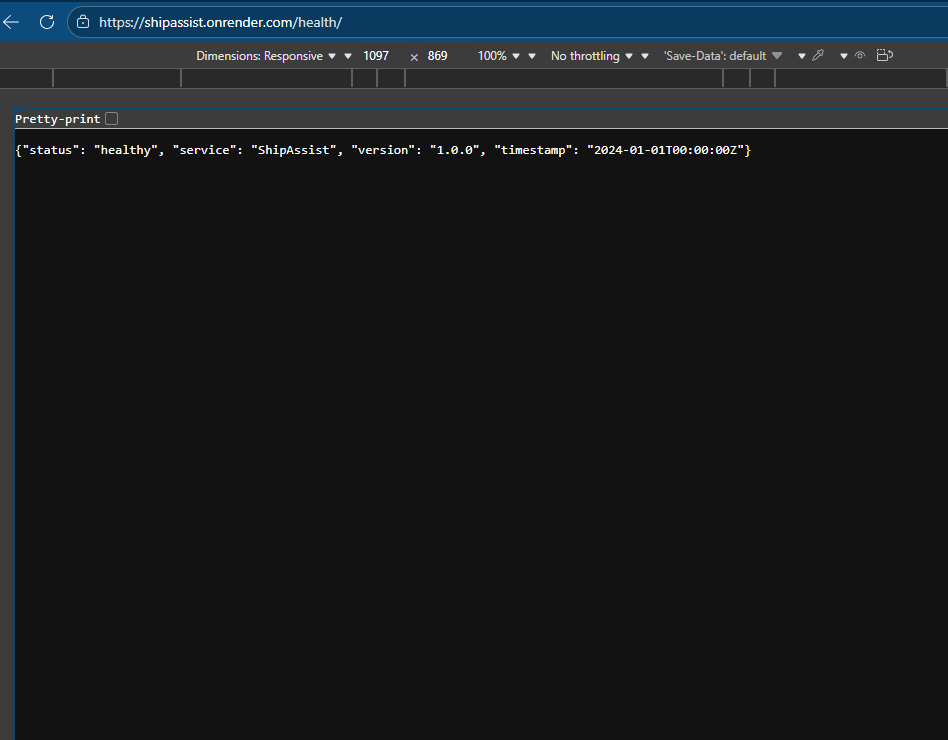
Live Health Check (Production) : https://shipassist.onrender.com/health/
AI Extraction (Rule‑based Fallback)


Links
- Source code (GitHub): https://github.com/ledidk/shipAssistWeb.git
- Live demo: pending Meta WhatsApp Cloud API production approval
Status
Backend core is completed. Next step is finalizing WhatsApp production approval and connecting the full end-to-end workflow for a live demo.
Other Projects
Une automatisation WhatsApp orientée backend qui détecte la langue, récupère le numéro de suivi et répond avec le statut d’envoi via des API et des outils IA.
Vue d’ensemble
Beaucoup d’entreprises de livraison répondent manuellement aux clients sur WhatsApp. ShipAssist aide à automatiser ces échanges pour donner des réponses rapides et cohérentes.
Ce que ça fait
- Reçoit les messages WhatsApp via webhooks (Meta WhatsApp Cloud API).
- Détecte la langue du client et répond dans la même langue.
- Récupère le numéro de suivi dans le message.
- Recherche le statut via une API ou un workflow.
- Envoie une réponse claire au client.
Comment ça marche (flux simple)
- Message client → webhook
- Validation + lecture du message
- Détection de langue + extraction du suivi
- Recherche du statut (API / workflow n8n)
- Réponse au client
Mon rôle / Ce que j’ai fait
- Conception de la structure backend et de la logique API avec Django et DRF.
- Création des endpoints webhook pour recevoir et vérifier les événements WhatsApp.
- Mise en place de la lecture, validation et gestion des réponses.
- Préparation des endpoints pour envoyer des messages et notifications.
- Configuration des accès et variables d’environnement (tokens, clés API, .env).
- Préparation de l’intégration avec n8n et des services externes.
Technologies
- Backend : Python, Django, Django REST Framework
- Intégrations : Meta WhatsApp Cloud API, Webhooks, API REST
- Automatisation : n8n (workflow), OpenAI (langue / compréhension)
- Outils : Git/GitHub, configuration (.env), Docker (prévu)
Captures
Health Check en production: https://shipassist.onrender.com/health/
Extraction IA (Fallback basé sur des règles)
Liens
- Code source (GitHub): https://github.com/ledidk/shipAssistWeb.git
- Démo live : en attente de l’accès production WhatsApp Cloud API
Statut
Le cœur du backend est prêt. Prochaine étape : finaliser l’accès production WhatsApp et connecter le workflow de bout en bout pour une démo live.